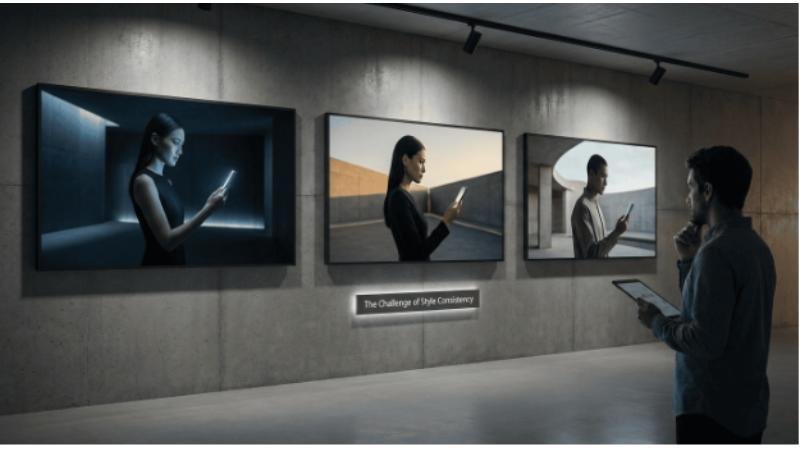
The initial thrill of using an AI image generator usually comes from the “slot machine” effect. You type a prompt, pull the lever, and receive a stunning, unexpected visual. For casual hobbyists, this randomness is a feature. For professional creators and brand managers, it is a significant roadblock. When you are building a multi-channel marketing campaign, you do not need one great image. You need fifty. You need them to share the same lighting, the same color grading, and the same character details across every frame. This requirement is known as style consistency, and it is currently the most difficult hurdle in the creative industry. Modern generative models are designed to be diverse. They explore a massive mathematical space of possibilities to provide variety. While this prevents the AI from becoming repetitive, it also makes it incredibly difficult to pin down a specific aesthetic for commercial use.
The Technical Challenge of Creative Drift
To understand why consistency is difficult, we have to look at how diffusion models operate. These systems start with a canvas of random noise and gradually refine it into an image based on your prompt. Every time you generate a new image, the starting noise is different. Even if you use the exact same prompt, a different “seed” value will result in a completely different composition. While professional platforms allow you to lock seeds, this only solves a fraction of the problem. If you change even one word in your prompt to adjust an action or setting, the entire mathematical trajectory of the image changes. This phenomenon is often called creative drift. A character might have blue eyes in one shot and green eyes in the next. A product might appear sleek and metallic in a close-up but look plastic and matte in a wide shot. For a brand, these discrepancies are unacceptable because they break the consumer’s immersion.
Why Generic Platforms Fail the Professional Test
Many entry-level tools are built for “one-off” art. They prioritize aesthetics over control. When a designer tries to use a basic ai image generator for a professional storyboard, they often spend hours fighting the model. They find themselves stuck in a loop of “prompt hacking” to get the lighting back to where it was in a previous iteration. This lack of control is exactly why professional studios are moving toward unified platforms. A pro-grade ecosystem like higgsfield addresses these issues by offering specialized models. Instead of relying on a single “jack of all trades” model, professionals can toggle between specific engines. For example, the Higgsfield Soul model is engineered specifically for professional aesthetics and high-fidelity human features. When you need something more abstract or experimental, you might switch to Seedream. Having these distinct “flavors” of AI allows for a more predictable baseline, which is the first step toward true consistency.
The Role of Specialized Engines in Branding
One of the most frequent “breaks” in style consistency occurs when text is involved. Most AI models treat text as a visual pattern rather than linguistic data. This results in the famous “gibberish” text that ruins an otherwise perfect brand asset. If your brand’s style includes specific typography or legible signage, you need an engine that prioritizes spatial awareness. In the higgsfield ecosystem, the Nano Banana Pro engine is designed to handle this specific challenge. It ensures that text is not just a decorative element but a functional, brand-accurate component of the image. According to a study on the limitations of generative visual models, the difficulty of maintaining spatial and textual logic stems from the way models compress data. Professional tools overcome this by layering specialized architectures on top of the base model to “force” accuracy where it matters most.
Strategies for Maintaining Style Across Campaigns
If you are struggling to maintain a cohesive look, you need to move beyond simple prompting. Professional workflows involve several layers of control to ensure every output looks like it belongs to the same collection.
- Use Reference Images for Color Grading Instead of describing a color palette in words, use a style reference. This tells the AI to analyze the “DNA” of an existing image and apply it to the new generation.
- Leverage Character Consistency Tools This is the “holy grail” of AI production. Features like Soul ID allow you to lock in a specific face or character profile. This ensures that your brand ambassador looks the same in a 4K studio portrait as they do in a lifestyle action shot.
- Standardize Your Lighting Prompts Always include a dedicated “Lighting Block” at the end of your prompts. Whether it is “golden hour,” “cinematic noir,” or “flat studio lighting,” keeping this string identical across all prompts helps anchor the visual mood.
- Work in a Unified Ecosystem Jumping between different tools is a recipe for stylistic disaster. By using a platform like higgsfield, you ensure that the underlying architecture remains the same. This makes it much easier to transition from a static image to a cinematic video without losing the visual identity of the project.
From Static Assets to Professional Video
Style consistency becomes exponentially harder when you introduce motion. In a traditional workflow, an editor might take a series of AI-generated images and try to animate them, only to find the textures “boil” or the backgrounds shift inconsistently. The modern professional approach is a seamless image-to-video pipeline. When your ai image generator is natively connected to a video engine, the transition is much smoother. The AI understands the depth, texture, and lighting of the source image, allowing it to generate motion that feels like it was filmed on the same set. This is where higgsfield excels for digital agencies. It provides the infrastructure to create 40 different ad formats in seconds, all while maintaining the high-budget studio look that brands demand. It is no longer about making “AI art”; it is about creating commercial visual production that is indistinguishable from traditional photography.
The Importance of High-Resolution Output
Consistency is not just about color and shape: it is also about quality. If one image is sharp and the next is blurry or pixelated, the campaign fails. Professional tasks require native 4K output to ensure that the assets are “commercial ready” for everything from social media ads to physical billboards. When working within higgsfield, the focus is on technical precision. The platform allows users to recreate viral ad references with high fidelity. This capability effectively democratizes professional cinematography, allowing small DTC brands to compete with global corporations that have massive production budgets.
Actionable Workflow for Creative Directors
If you are leading a team, you should implement a “Style Guide” for your AI prompts. This guide should act as the manual for your ai image generator usage.
- Define the Model: Specify if the project uses Flux.1 for realism or Seedream for creative flair.
- The Base Prompt: Create a “seed prompt” that contains the core aesthetic parameters.
- Aspect Ratio Locking: Ensure all assets are generated in the correct format from the start.
- Final Upscaling: Use a consistent upscaling method to maintain uniform grain and texture across all 4K exports.
By treating the ai image generator as a sophisticated piece of studio equipment rather than a magic box, you can achieve results that were previously impossible. Consistency is not something the AI does for you; it is something you achieve through the right tools and a disciplined workflow.
Conclusion: Mastering the AI Creative Engine
Style consistency is the difference between a curious experiment and a professional asset. While the “drift” inherent in AI can be frustrating, it is also what makes the technology so powerful. The key is to find the balance between AI’s creative randomness and the human need for control. Using higgsfield provides that control. By unifying top-tier models and providing specialized tools for characters and text, the platform transforms AI from a toy into a professional studio. Whether you are a digital agency or a solo creator, mastering these consistency strategies will allow you to produce content that is repeatable, scalable, and truly indistinguishable from high-budget studio production. In the era of rapid digital consumption, the brands that win are the ones that can produce high-quality content at scale. By solving the consistency puzzle, you unlock the ability to tell a coherent brand story across every digital touchpoint.