
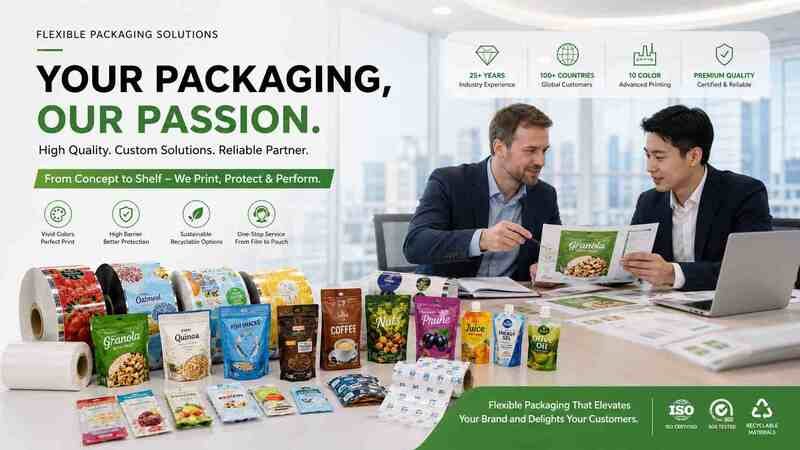
Sustainability isn’t a buzzword anymore. For brands competing in today’s market, it’s a business requirement. Consumers read labels. Retailers set packaging commitments. Regulators are tightening extended producer responsibility rules in more markets every year. And somewhere in the middle of all this, brand managers and packaging buyers are figuring out how to meet these expectations without blowing up their production costs. Sustainable flexible packaging has emerged as one of the most practical paths forward. It offers real environmental improvements — less material, lower transport emissions, recyclable or compostable options — while remaining cost-competitive with conventional packaging.
Why Flexible Packaging Is a Strong Starting Point for Sustainability
The core reason is material efficiency. A flexible pouch holding the same volume as a rigid plastic container typically uses 60 to 70 percent less plastic by weight. Less material means lower energy consumption in production, less raw material extracted, and fewer emissions across the supply chain.
Transportation is another area where flexible formats have a natural advantage. Empty packaging ships flat and takes up far less space than pre-formed rigid containers. This means more units per truck, fewer trips, and meaningfully lower transport-related emissions — before the product is even added. Just as optimizing consumer freight space drops overall carbon emissions for retail supply chains, similar eco-conscious efficiency trends are emerging in large vehicle logistics, where shippers frequently lean on carbon-offsetting marketplaces like https://www.shiply.com/
Sustainable Flexible Packaging Materials: What’s Actually Available
Mono-Material Films
One of the most significant developments in recent years has been the commercialization of mono-material films. Traditional flexible packaging is often a laminate — multiple layers of different materials bonded together. The problem is that mixed-material laminates are extremely difficult to recycle.
Mono-material films solve this by engineering a single polymer — most commonly polyethylene or polypropylene — to perform multiple functions. These films are recyclable through plastic film drop-off programs, which are increasingly available at grocery stores and retail locations. For a wide range of food, personal care, and consumer goods applications, they’re a viable option today.
Compostable Packaging
Compostable flexible packaging is made from plant-based materials — typically polylactic acid (PLA), cellulose, or starch-based blends — that break down into natural compounds under industrial composting conditions. For brands targeting the premium natural and organic market, compostable packaging offers a strong sustainability story.
The key limitation is infrastructure. Compostable packaging only delivers its environmental benefit if it reaches an industrial composting facility. In markets where this infrastructure is limited, the real-world benefit can be lower than expected. That said, for direct-to-consumer brands and companies in markets with strong composting programs, it’s a credible and increasingly practical option.
Recycled Content Films
Post-consumer recycled (PCR) content films incorporate plastic that has been collected, processed, and remanufactured into new film. Using PCR content reduces the demand for virgin plastic and supports the economics of recycling infrastructure. PCR content levels in flexible films typically range from 25 to 50 percent, with higher percentages becoming available as processing technology improves.
Bio-Based Plastics
Bio-based plastics are derived from renewable plant-based feedstocks — sugarcane, corn starch, or cassava — rather than fossil fuels. Sugarcane-derived polyethylene (bio-PE), for example, is chemically identical to conventional PE and fully recyclable through the same channels, but its carbon footprint is significantly lower because the sugarcane plant absorbs CO2 as it grows.
Eco-Friendly Packaging in Practice: What Does the Switch Actually Look Like?
For brands considering a move to more eco-friendly packaging solutions, the process typically involves a few key steps. First, understanding the current baseline — what materials are used today, what their environmental footprint looks like, and what performance requirements are non-negotiable. Second, identifying which sustainable alternatives can meet those requirements. Third, running trials to validate performance before full commitment.
Brands that have successfully made the switch consistently say the same thing: the planning takes longer than expected, but the operational reality is less disruptive than feared. And the commercial benefits — sustainability credentials, improved consumer perception, and readiness for evolving regulations — more than justify the effort.
Green Packaging as a Brand Asset
For brands that get this right, green packaging isn’t just a cost center — it’s a genuine brand asset. Packaging that communicates sustainability credentials on the shelf, through certification logos, clear material descriptions, and disposal instructions, builds consumer trust over time.
This is particularly true in categories where the consumer’s values are closely tied to the brand’s positioning — natural and organic food, clean beauty, wellness products. In these categories, the packaging is part of the product story, and sustainable packaging gives brands a credible, visible way to tell it. Companies like Contipack Inc work with brands across industries to find flexible packaging solutions that align performance requirements with sustainability goals — without forcing brands to choose one over the other.
What to Watch for in 2026 and Beyond
Chemical recycling — which breaks flexible films back down to their base chemicals for re-polymerization — is scaling up and holds the potential to recycle multi-layer laminates that can’t currently be mechanically recycled. This would significantly expand the recyclability of formats that have historically been difficult to handle at the end of life. Extended producer responsibility (EPR) legislation is also expanding. More jurisdictions are implementing fees on packaging based on its recyclability or recycled content, which shifts the financial equation for brands considering sustainable alternatives. Companies that have already transitioned will be better positioned when these regulations take effect.
Final Thoughts
Sustainable flexible packaging for brands isn’t a single product or a single decision. It’s a strategy that involves understanding your materials, your supply chain, your consumers, and the regulatory landscape you operate in. The good news is that the options are better today than they’ve ever been. Brands that approach this strategically — choosing the right materials, communicating authentically, and working with the right flexible packaging partners — will find that sustainability and business performance aren’t in conflict. They reinforce each other.