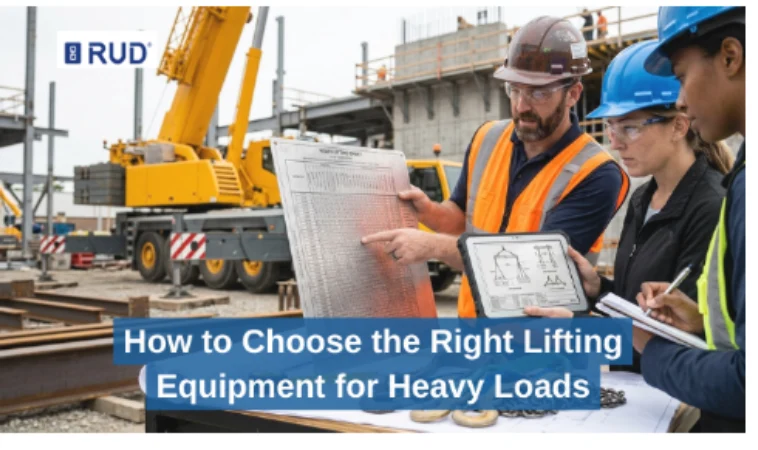
You can choose the right lifting tool by matching the load, site conditions, and Australian compliance requirements. But making that decision is often harder for many site managers. There are dozens of equipment types rated differently, which takes more than a quick product search to find the right one.Frankly, heavy-lifting failures are rarely accidental. Most of them trace back to gaps in planning, mismatched rigging gear, or teams choosing tools without properly checking the lifting capacity. That’s exactly why RUD Australia has been helping Australian industries make these decisions right for over 40 years.
This article covers what goes into safe lifting tool selection, including load geometry, site conditions, rigging solutions, and the right lifting gear for the job. Read on to select the right lifting equipment with confidence for the future.
Lifting Equipment Australia: What the Right Choice Actually Depends On
Most operators don’t realise how many lifting equipment failures begin long before the lift itself starts. In many cases, poor planning, incorrect assumptions about the load, and overlooked site conditions lead teams toward the wrong choice.
In practice, two factors sit at the centre of every good lifting decision: the load itself and the site where the lift takes place. When you get both of them right, the lifting tool selection becomes clearer.
Let’s have a look at the main areas worth assessing before the lift begins:
Load Weight, Geometry and Centre of Gravity
Incorrect weight estimation is one of the leading causes of lifting failures on-site because rigging gear generally operates within specific working load limits. So even a small miscalculation here can push the entire lift outside the safe operating range, which can cause an accident.
The load balance creates another challenge during the lift. When the centre of gravity sits off-centre from the lifting point, more weight shifts onto certain sling legs instead of spreading evenly across the rigging.
As that imbalance increases, the load start tilting, sling angles begin changing, and stress builds through the rigging system quickly.
For these reasons, many riggers use adjustable lifting points and multi-leg rigging configurations for uneven loads. In our experience working across Australian lifting operations, repositioning attachment points before the lift begins distributes weight evenly and keeps the load stable throughout.
Site Conditions and Working Environment
Outdoor sites, confined spaces, and overhead clearance all influence which lifting equipment is actually usable for a specific job. For example, a chain hoist that works perfectly in a workshop may be completely impractical on an open construction site with limited anchor points.
What’s more? Environmental exposure, like corrosion, creates pressure on the lifting gear. For instance, if your workplace resides near the coast in Queensland, salt air alone can degrade standard chain grades within months without the right material specification.
Beyond coastal sites, industries like mining and manufacturing face similar wear from heat, dust, and chemical exposure.
Temperature also affects long-term equipment performance. Specifically, high heat weakens chain and rigging components gradually over time. And in Australian industrial operations, summer conditions push that wear further than most spec sheets account for.
With site conditions mapped out, the focus shifts to which type actually fits the job.
Heavy Load Lifting: The Main Equipment Types Explained
If you understand your options upfront, you’ll have fewer delays, safer lifts, and less guesswork on site. In fact, different lifting tasks place different demands on the gear, so choosing the right setup depends on how and where the lift takes place.
Two equipment types cover the bulk of heavy lifting work on Australian sites, and knowing how each one works makes selection simpler.
Chain Slings and Rigging Systems
Many site operators tend to misuse chain slings in Australian worksites due to a lack of knowledge about sling grade and configuration. These factors directly affect the safe working load for any project. As a result, a mismatch between them can place dangerous stress on the entire rigging system.
And better load stability starts with adding more attachment points to the setup. After all, multi-leg rigging systems spread the load across multiple attachment points for better stability and control. The more legs in the configuration, the more evenly the weight is distributed on the rigging system.
If you have to move heavy or uneven loads, a two or four-leg configuration gives far better results than a single sling.
For example, RUD Australia supplies Grade 100 VIP and Grade 120 ICE chain slings on single and multi-leg configurations. Both options give site managers a clear path to matching load requirements with the right quality standard.
Lifting Points and Spreader Beams
Experienced operators often use swivel lifting points for awkward load profiles as they allow natural load movement into the rigging. To be more specific, the swivel function lets the load rotate freely at the attachment point, so that rotational force dissipates at the connection rather than travelling back through the sling.
Swivel lifting points also provide a fixed, rated anchor for attaching slings and hooks directly to the load. As a result, the team has a secure, stable connection point before the lift begins.
In comparison, spreader beams work differently. They keep sling legs vertical during a lift by removing inward compression forces and giving operators better position control over the load. Without a spreader, those forces can damage the load itself, particularly on fragile or irregularly shaped objects.
Manual Handling Injuries and Why Equipment Selection Counts
Poor equipment selection puts workers at direct risk of manual handling injuries, which remain among the most common serious compensation claims in Australia.
According to Safe Work Australia’s 2025 Key Work Health and Safety Statistics report, body stress (which includes lifting, carrying, and handling loads) accounted for 34.5% of all serious workers’ compensation claims in Australia. And this number hasn’t budged much in years.
The problem usually starts when the tool cannot properly handle the task on site. Workers then step in physically to manage the gap. They push, carry, and strain to manage loads on site that the right gear should already control. Over time, such physical strain leads to injuries, dropped loads, and real workplace safety risks.
From what we’ve seen across Australian industrial sites, the right choice consistently cuts both injury rates and unplanned downtime. It also protects the efficiency of the whole operation.
Basically, selecting the right lifting solutions is as much a productivity decision as it is a safety one.
Industrial Lifting Solutions: Getting Expert Advice Before You Buy
Once you know what your lifting job demands are, pair that knowledge with a supplier who understands Australian lifting requirements.
Specifically, three things separate a good supplier from the rest:
- Field Experience: Working on construction, mining, and manufacturing sites gives experienced suppliers a much clearer understanding of real lifting risks. This hands-on experience allows them to identify problems beyond product catalogues and technical specifications.
- An Extensive Product Range: A specialist provider stocks chain slings, spreaders, hooks, and other lifting equipment across a full product range. As a result, your team gets the right gear for the task without compromising on safety or quality.
- Compliance and Inspection Support: Beyond supplying the equipment itself, strong providers also support inspections, compliance checks, and ongoing training. That ongoing support helps teams keep lifting operations safe and compliant long after the tool arrives on site.
In short, early expert advice reduces workplace risks, builds productivity, and puts more confidence behind every lifting decision.
Your Next Step Starts Here
Choosing the right lifting tool isn’t a one-size-fits-all decision. Every project brings different load requirements, site conditions, and compliance obligations that need to work together before a single lift begins.
Once you get the rigging gear, slings, and lifting solutions right from the start, your workers are protected, and operations run without unnecessary interruption. This consistency directly supports long-term productivity across Australian industries.
Ready to make a more confident equipment decision? Contact RUD Australia today. Our team brings over 40 years of local expertise and an extensive range of lifting equipment to support your operation across any industry or project scale.